Thursday, November 17, 2011

Romney Derangement Syndrome Part II - The Search for Ann Coulter's Brain

Ann Coulter, who I usually find entertaining, posted an article yesterday which I think is a great example how some conservatives have become lobotomized by Mitt Romney.  In it, she trashes Newt and tells you to vote for Romney and not even criticize him until after the general election (I didn't realize we were in a coronation?).  Anyway, let's go through it shall we:

So now, apparently, we have to go through the cycle of the media pushing Newt Gingrich. This is going to be fantastic.

In addition to having an affair in the middle of Clinton's impeachment;

I didn't know that having an affair was an impeachable offense?  Oh wait, it's not, committing perjury is, which is what Clinton was being impeached for.  Also, in Newt's defense, he might have affairs but he does actually manage to marry his mistresses and has been married to Callista for 11 years now.  I don't seem to remember Clinton ever marrying Lewinsky or any of the other girls he was schtuping.  There is a difference between falling in love and getting married and throwing girls away like kleenex right?

 apologizing to Jesse Jackson on behalf of J.C. Watts -- one of two black Republicans then in Congress –- for having criticized "poverty pimps," and then inviting Jackson to a State of the Union address;

I'm sure the apology was just damage control.  I don't think many remember or care about this incident (or even remember when J.C. Watts was considered a rising star).  This is like some sort of longstanding inside the beltway grudge with Coulter isn't it?  Not that I don't hate Jesse Jackson.  Anyone who refers to New York as "hymie town" is a special kind of a**hole.  I'll just leave it at that.

cutting a global warming commercial with Nancy Pelosi;

I'm definitely in the global warming skeptic camp (I'm not sure the Earth is warming, and even if it is, it is probably due to solar effects, which can't be changed by us destroying our economy) so I definitely don't like that commercial.  But he doesn't actually say anything that bad in that commercial, he is pretty much just pimping green energy.  Big deal.  Even I think that would be nice (though I don't think government should be involved).

supporting George Soros' candidate Dede Scozzafava in a congressional special election;

I didn't like Scuzzy Face at all and supported Doug Hoffman, the conservative candidate.  But in the end, Newt was unfortunately correct.  Check this quote out, ""I just think it is a mistake for the conservative movement to think splitting in the special election is a smart idea, If we give that seat to the Democrats, shame on us." And that seat, which had been Republican for decades, has now fallen to the Democrats for two elections because the conservatives keep splitting the vote between the GOP and the Conservative party.  So he was correct.  Oh and once Scuzzy Face left the race officially, Newt did endorse Hoffman.

appearing in public with the Rev. Al Sharpton to promote nonspecific education reform;

Oh my god, the specter of nonspecific education reform!  I am certainly no fan of Al Sharpton, who should probably rot in hell for the blood on his hands, but you really have to do better than that.

and calling Paul Ryan's plan to save Social Security "right-wing social engineering,"

Admittedly not his finest hour, though Ann, I believe the plan only changed Medicare, Social Security was decidedly absent.  I guess the Romney lobotomy took that fact out of your head.  Anyway, Newt, unlike other politicians actually did apologize personally to Ryan for that.  I believe his thought process for that charge was just that it was too big a leap which from a tactical political point of view could be true (as it could keep you from winning elections and actually implementing that plan or any reform plan).

we found out this week that Gingrich was a recipient of Freddie Mac political money.

I'm pretty sure that every politician, while either looking for office or while in office has received political contributions from quite a few organizations, many of which we might not agree with.  But that doesn't seem to be an issue, usually.  So what's the big deal about a private citizen doing some consulting work?  There was nothing illegal, nothing improper.  How can you begrudge people making a living in the private sector?

The mainstream media keep pushing alternatives to Mitt Romney not only because they are terrified of running against him, but also because they want to keep Republicans fighting, allowing Democrats to get a four-month jump on us.

Meanwhile, everyone knows the nominee is going to be Romney. 

This argument makes no sense and is pretty unhinged.  So the mainstream media are pushing alternatives to Romney?  If they are so afraid of Romney why aren't they trying to cut him down with hit pieces?  Unlike the other candidates, he is the only top contender who has been pretty much unscathed by any sort of media scrutiny.  And it isn't that hard to find stuff.  Romney said that Romneycare was paid for, unlike Obamacare. But as one of the architects of Romneycare mentioned in a pretty colorful interview, "they're the same f*cking bill".  Basically the only reason that Romneycare was paid for was because of federal subsidies (essentially, you and me are paying for Romneycare).  Has this been brought up by the press recently?  Or at the debates by moderators?  Nope, Romney gets no scrutiny and only softball questions.  The media is completely in the tank for Romney, just as they were in the tank for McCain.  Now Newt, he will drive them bonkers.  They will go completely unhinged.

Also, not everyone knows that Romney will be the nominee.  He still can't break out of his 22-25% range, not for more than one poll.  That sounds like at least 3/4 of GOP voters still don't like him.

That's not so bad if you think the most important issues in this election are defeating Obama and repealing Obamacare.

Does anyone really believe that Obamacare is going to be repealed under Romney?  He said he is going to issue waivers to all 50 states, but that doesn't waive Obamacare, just a tiny aspect of it.  To repeal Obamacare you will have to fight tooth and nail.  Is Romney really going to do that for a bill that so closely resembles his pride and joy?  Also, having a moderate like Romney as the GOP candidate opens the door for a third party run by someone like Ron Paul, who would see a lot of conservatives offer him their protest vote, giving the election to Obama.

There may be better ways to stop Obamacare than Romney, but, unfortunately, they're not available right now. (And, by the way, where were you conservative purists when Republicans were nominating Waterboarding-Is-Torture-Jerry-Falwell-Is-an-Agent-of-Intolerance-My-Good-Friend-Teddy-Kennedy-Amnesty-for-Illegals John McCain-Feingold for president?)

Uhh, I think we were lamenting the fact that our choice was McCain or Romney or Huckabee?  There really weren't any good choices in that election, that is where we were.

Among Romney's positives is the fact that he has a demonstrated ability to trick liberals into voting for him. He was elected governor of Massachusetts -- one of the most liberal states in the union -- by appealing to Democrats, independents and suburban women. 

Didn't he implement universal healthcare?  So how were the liberals tricked exactly?  Didn't they get exactly what they want?  By voting for Romney for President, the only people that will be tricked will be conservatives.


He came close to stopping the greatest calamity to befall this nation since Pearl Harbor by nearly beating Teddy Kennedy in a Senate race.

This reminds me of the intro for Brave Sir Robin in Monty Python's Holy Grail "Sir Robin the - not - quite - so - brave - as - Sir Lancelot, who had nearly fought the Dragon of Angnor, who had nearly stood up to the vicious Chicken of Bristol, and who had personally wet himself at the Battle of Badon Hill!".  Also, a famous quote about horseshoes and hand grenades comes to mind.

He is not part of the Washington establishment, so he won't be caught taking money from Freddie Mac or cutting commercials with Nancy Pelosi.

True, he is a Washington outsider but unfortunately acts like a slick Washington insider.  Oh and which group other than Freddie Mac is often blamed for the housing crisis?  Oh yeah, Wall Street.  Where Romney worked for years and where he currently gets most of his donations from.  Like we won't be deluged with articles about that when he is nominated.  Also, I'm pretty sure you'll find sob stories of people who lost their jobs because of actions by Romney when at Bain. 

Also, Romney will be the first Republican presidential nominee since Ronald Reagan who can talk. Liberals are going to have to dust off their playbook from 30 years ago to figure out how to run against a Republican who isn't a tongue-tied marble-mouth.

How is this a case to nominate Romney over Newt?  I think in a head to head debate, Romney would get creamed by Newt. And everyone knows it.  Also, if he can talk so well, how come he has been so silent.  He hasn't been giving any interviews lately.

As we've known for years, his negatives are: Romneycare and Mormonism.

We look forward with cheery anticipation to an explosion of news stories on some of the stranger aspects of Mormonism. The articles have already been written, but they're not scheduled for release until the day Romney wraps up the nomination. 

I thought his negatives were Romneycare and the fact that he doesn't believe in anything.  He is a fake, the Dorian Gray of the GOP.  I really don't think people care about his religion, not outside the usual cranks anyway.

To the contrary, when his father, George Romney, was governor of Michigan, he was the most pro-civil rights elected official in the entire country, far ahead of any Democrat. 

Oh yeah, let's talk about his father.  Liberal George Romney who opposed Reagan and the war in Vietnam.  How far does the apple fall from the tree these days/

No one is worried Romney will double-cross us on repealing Obamacare. We worry that Romneycare will make it harder for him to get elected. 

I don't know, I'm pretty worried.  I'm sure a lot of people are.   Maybe the voices in Ann Coulter's head aren't.  Maybe she should stop speaking for the rest of us.

He's already explained how mandating health insurance in one particular wealthy, liberal Northeastern state is different from inflicting it on the entire country. Our Constitution establishes a federalist system that allows experimentation with different ideas in the individual states.

Oh, he explained it, that makes it all better.  Again, Massachusetts might be wealthy but they wouldn't have Romneycare without federal subsidies.

Instead of sitting on our thumbs, wishing Ronald Reagan were around, or chasing the latest mechanical rabbit flashed by the media, conservatives ought to start rallying around Romney as the only Republican who has a shot at beating Obama. We'll attack him when he's president.

We'll attack Romney when he's President?  Awesome.  Let the coronation begin!  Seriously, is Ann Coulter on meth or something?

Wednesday, November 16, 2011

Romney Derangement Syndrome

There is a disease going around some right wing pundits.  They seem to be disregarding their usual intelligence and analytical abilities and have become brainwashed minions of Mitt Romney.  I really can't explain it.  Take Jennifer Rubin at the Washington Post, who I have read for a while now, both at WaPo and at Commentary who seems to be one of the worst of the Romney pod people pundits.  She has spent columns nitpicking every single thing that people like Perry, Cain and Newt have said (she even criticized the Cain 999 plan for being insufficiently progressive, that is the whole point!) but has nary a word to say that would criticize Mitt Romney.  She even stoops to misleading commentary to make points in his favor. Take her column today (please) titled "Resigned to Mitt Romney" which starts:

Reading right-wing commentary or listening to talk radio would give you the impression there is great aversion, even loathing, of Mitt Romney among Republicans. The reality is very different, suggesting that the chorus of "anybody but Mitt" for their presidential candidate is more a function of the media than of actual voter sentiment.

Really?  It's not about actual voter sentiment?  Has she seen the polls?  Mitt has been running for President this election cycle since Obama was elected and yet has a national polling average of around 22% which is pretty much no different than what he had during the 2008 primary season.  So after 3 years and at least 4 competitive candidates imploding (Pawlenty, Bachmann, Perry and Cain) Romney's support has not inched up one iota amongst Republicans.  If there wasn't great aversion to Romney, you would have expected him to have picked up at least some of the voters from those competitors, especially the 5-6% who have supported Pawlenty, given he has endorsed Romney.  Nope.  No bumps anywhere.  Now take a look at how her next paragraph where she cherry picks data from gallup, ignoring important data from the same poll:

Take for example the latest Gallup poll. According to that survey, Romney has the highest total favorable rating (67 percent) and the lowest unfavorable rating (24 percent) of any candidate.

You know who #2 is for favorability?  Herman Cain at 66%.  #3?  Newt at 65%.  From a statistical point of view, this is a tie.  The same goes for the unfavorable rating where Cain and Newt are both at 26%.  So statistically, on that metric, Romney is really no better than the other two contenders.  Importantly, Ms. Rubin completely ignores the positive intensity score rankings from Gallup.  This is where they take those who strongly favor a candidate and subtract those that have a strong dislike for a candidate (this ignores those that have more muted feelings towards a candidate).  In this score, Newt and Cain score the best at 17, while Romney is only at 10.  I'm sorry, GOP voters are just not that into Mitt.  Also, most importantly, this survey includes GOP leaning independents, who might not vote in many primaries and they are probably skewing the data for Romney.  So again, after campaigning for years and having the largest war chest of any candidate and having done the best, besides Newt, in the debates, Romney is still unable to get more than a fraction of GOP voters to back him and quite a few to openly hate him.

He may be a non-starter or ultimately unacceptable to a significant number of conservative pundits and hard-core Tea Partyers, but there is little reason to doubt that he could pull the party together if he does take the nomination.

Hard core tea-partiers? You mean the people who came out in droves to hand the GOP the House of Representatives in 2010?  I don't think we'd have much of a party without them.  Also, I think many Republicans are sick of voting for Democrat-lite candidates who don't stand up for conservative beliefs, the Bob Dole's, the John McCain's, one or both of the Bushes.  Hell, even Jimmy Carter has said he would be "very pleased" if Romney won the nomination.

The worst part is that Romney supporters can't even tell us why we should be supporting him besides the whole electability thing (even Ann Coulter), which may not even be true.  Just think about this scenario, what if the anger of conservatives and "hard-core tea partiers" leads someone like Ron Paul to run on a third party ticket?  This could hand the election straight to Obama and would be more likely to happen under a Romney candidacy than one of a more conservative candidate who has more overlap with a Ron Paul (at least economically). 

When you take away Romney's electability what do you have?  His 59 point plan which looks like it was written by a Bain consultant (lots of pretty pictures with not a lot of real content).  And some of his policies seem purely for rhetorical purposes.  He wants to eliminate capital gains taxes, but only on the people who pay almost no capital gains taxes.  He thinks Obama's decision to withdraw the surge troops from Afghanistan in September 2012 is a mistake, but only because he would withdraw them in December, just three months later.  And Romney seems to know that his positions are a joke or else he would be giving more interviews.  It seems you see Newt everywhere, just about every day.  He does both personal campaigning as well as interviews for the media (both mainstream and conservative).  Romney, on the other hand, is pretty much nowhere to be seen.  You don't see him doing interviews and usually when I check his calendar on Politico it has one event.  And today it's empty!  Either he is spending all his time at fundraisers or he is afraid of scrutiny.  He is probably both.

The establishment of the Republican Party needs to stop trying to nominate people who they, in their infinite wisdom, think have the best chance of beating Obama, but instead try to nominate people who will actually govern from the right.  We don't need perfection, we just want someone who we have confidence will do the right thing most of the time.  Romney just ain't it.  Also, it would be nice if they didn't try to blow everything a conservative says out of proportion in order to help their friend Mitt, as Jennifer Rubin laughably attempted to do by criticizing Newt's talk of zero-based foreign aid as a threat to Israel (one of the first things he will do as President is move the embassy to Jerusalem, I don't think Israel has to worry under President Newt!).   I expect that much from the lamestream media, not from people we are supposedly allied with.

Tuesday, November 15, 2011

Newt Will Be Surprisingly Tough to Bring Down

Now that Newt has become a top contender, according to some of the most recent polls, the knives are out, both on the left and the right.  The common theme is that the Newt boomlet will pass, just as it did for Perry and Cain, as the candidate gets greater scrutiny due to his poll numbers.  These snarky pundits though are going to be in for a surprise when Newt proves far more resilient than they thought, for one reason, expectations.  My years in finance have taught me a few things, one of which is that expectations are often more important than the intrinsic quality of a company in determining future performance.  A crappy company that starts to consistently beat expectations will most likely outperform the great, brand name company, that has started to miss them. 

The reason that Perry flamed out was that people, without really knowing him, expected him to be a competent big-state conservative Governor with a great record and Reagan hair.  Instead, he turned out to be not as conservative as advertised with his competency coming into question with not just one but two major senior moments in the middle of nationally televised debates.  Cain, though an unknown with no political experience, was expected to be a competent administrator given his successful business career.  Instead, he has run an incompetent campaign, focusing more on his book tour than anything else and he seems to know less about foreign policy than a 3rd grader in Appalachia.  His recent Libya flub was really painful to watch.  Also, he completely mishandled the sexual harassment allegations against him (despite knowing the Politico story was coming 10 days in advance) giving at least 3 different responses in the course of 24 hours.  For someone who people expected to at least be a competent administrator, he seems to be anything but.  He is disorganized and uninformed.  It is no wonder his campaign has started to implode.

Newt, on the other hand, is a known quantity.  People already know of his imperfect conservative record and his sordid personal history, and they are supporting him in the polls despite all that.  To bring Newt down, you will actually have to surprise people with something you find.  However, given his record was combed over by Clinton and his minions, you kind of get the idea there probably isn't anything major that people missed before 1999.  And so far there really hasn't been anything major that people have found since then.  The $300,000 advisory fee from Freddie Mac in 2006 is not it.  I don't think anyone begrudges him from making a living after a lifetime of public service, especially one that is not obviously immoral.  Unless he actually cold-called subprime borrowers and tricked them into signing away their houses, this will not stick.  Neither will most of anything else that people dig up, unless they found out he is Sanduskie's best friend or was head of his local KKK.  It's just like with Romney and his flip flops.  The 25% of GOP voters who like him will not change their mind because of another flip flop.  They know and have accepted the fact that Romney bends like a reed in the wind, so another flip flop is just not a surprise to anyone.

Now I am not saying Newt is unstoppable, of course he is.  Because he lacked in funding for so long, he also lacked organization.  So it is unclear how effective he will be in getting out the vote for him in the caucuses and primaries and on capitalizing on any victories.  Lack of a large campaign infrastructure has a much greater chance of torpedoing his candidacy than anything dug up in opposition research.

The Real 99%


(h/t Powerline)

Monday, November 14, 2011

Is Mitt Romney a Pretend Hawk?

Since deciding to run for President again, Mitt Romney has been trying to do 2 things, appear conservative economically and hawkish militarily.  While his attempt to appear conservative has been sabotaged thanks to a wealth of YouTube videos and his record as Governor of Massachusetts, his attempt to appear hawkish has not received the same debunking, mostly due to a lack of evidence (Governor's of Massachusetts luckily can't run their own foreign policy).  Also, his speech at the Citadel and his recent Op-Ed in the Wall Street Journal on Iran titled " I Won't Let Iran Get Nukes" really did sound good.  As if finally conservatives could feel comfortable about one area of Romney's beliefs so that if he does win in 2012, you won't just be biting your pillow in rage ever time you hear of one of his policy moves.  Unfortunately, the CBS/NJ debate on foreign policy really elucidated how there will likely be a major disconnect between what Romney campaigns on and what Romney actually does.  First, let's take a look at his response to a very straightforward question on Iran, which I think is one of the most important foreign policy issue/threat that we are facing today:

Scott Pelley: Governor Romney, would it be worth goin' to war to prevent Iran from obtaining a nuclear weapon?

Mitt Romney: Well, let's-- let's start back from there and let's talk about where we are. This is, of course, President Obama's greatest failing, from a foreign policy standpoint, which is he recognized the gravest threat that America and the world faces-- and faced was a nuclear Iran and he did not do what was necessary to get Iran to be dissuaded from their nuclear folly. What he should have done is speak out when dissidents took the streets and say, "America is with you." And work on a covert basis to encourage the dissidents.

Number two, he should have put-- put in place crippling sanctions against Iran. But instead of getting Russia, for instance, to-- what-- what he gave in our-- our missile defense system to agree to-- to stand with those crippling sanctions, he gave Russia what they wanted, their number one foreign policy objective, and got nothing in return.

...

(Successfully argues with moderator over the time after being prematurely cut off)
...

Mitt Romney: Fin-- finally, the president should have built credible-- threat of military action, and made it very clear that the United States of America is willing, in the final analysis, if necessary, to take military action to keep Iran from having a nuclear weapon. Look, one thing you can know-- and that is if we reelect Barack Obama, Iran will have a nuclear weapon. And if we elect Mitt Romney, if you'd like me as the next president, they will not have a nuclear weapon.

Scott Pelley: But sir, let me-- you just described where we are today, and that's what you're going to have to deal with if you become president. How do you prevent them from obtaining a nuclear weapon? Is it worth going to war to prevent that?

Mitt Romney: Well, it's worth putting in place crippling sanctions. It's worth working with the insurgents in the company to encourage regime change in the country. And if all else fails, if after all of the work we've done, there's nothing else we can do beside mil-- take military action, then of course you take military action. It is unacceptable for Iran to have a nuclear weapon.

We will not allow Iran to have a nuclear weapon. This term "unacceptable" has been applied by several presidents over history, and our current president has made it very clear that he's not willing to do those things necessary to get Iran to be dissuaded from their nuclear folly. I will take a different course. I will make sure that the sanctions, diplomatic pressure, economic pressure, and support of insurgents within the country help them become dissuaded to get away from their nuclear ambition. And finally--

Scott Pelley: This time, it is time.

Mitt Romney: Yeah, and finally, have to-- have to have military presence there.

Romney is asked a very straightforward question on Iran, is it worth going to war with Iran to prevent it from getting nukes and instead of a "yes, because" sort of answer, he gives a really long-winded answer which focuses on sanctions (when was the last time they worked to make a major adversary fold?  Especially in the short amount of time that we have before Iran does develop nukes), help to the opposition (covertly) and a "credible threat" of military action (which of course is different than actually taking military action).  Even Scott Pelley felt the need to re-ask the question because it was very clear that Romney didn't answer it the first time around.  I really did not get a good feeling watching that answer on TV because it sounds like Romney would actually simply be a slightly more hawkish Obama with regards to Iran.  How long are we supposed to wait for sanctions to work after all?

Then there was the question about Afghanistan:

Major Garrett: Governor Romney, a much smaller footprint in Afghanistan? Do you support that? And secondarily, sir, is it time or would it ever be time for the United States to negotiate with the Taliban?

Mitt Romney: We don't negotiate with terrorists. I do not negotiate with the Taliban. That's something for the Afghans to decide how they're gonna-- pursue their course in the future. With regards to our footprint in Afghanistan, the right course is for us to do our very best to secure the victories that have been so hard won by the soldiers, the men and women of-- of our-- fighting forces who have been in Afghanistan.

The commanders on the field feel that we can take out 30,000 to 40,000 troops sometime by the end of next year. The commander in chief, perhaps looking at the calendar of the election, decided to bring them home in September, instead, in the middle of the fighting season. Our commanders said that puts our troops at risk, at danger, "Please don't pull 'em out there," they said.

But he said, "No, I'm gonna get 'em out early." I think that was a mistake. Our surge troops should have been withdrawn by December of next year, not by December. And the timetable, by the end of 2014, is the right timetable for us to be completely withdrawn from Afghanistan, other than a small footprint of support forces.


His big argument with Obama on Afghanistan is that the surge troops should be withdrawn in December instead of September?  That's it?  While I do understand that withdrawing troops in the middle of the fighting season is clearly a mistake, I would hope a GOP nominee has a greater difference in policy than 3 months in a timetable.  Also, he is for us withdrawing completely by 2014?  What happened to working for our victory?  This just seems like a replay of Vietnam where the debate was over the pace of withdrawal instead of over strategies to actually win (in fact, we were turning the tide thanks to the Creighton Abrams strategy there but we weren't able to see it through due to wishy washy politicians back home who waffled on the war, like Mitt's father George). 

And then there is the question of safe havens for insurgents in Pakistan:

Scott Pelley: Governor Romney, would you send American troops across the border into Pakistan to clear out those save havens? American men and women are coming under fire from those locations every single day.

Mitt Romney: The right way to deal with-- Pakistan is to recognize that Pakistan is not a country like other countries, with a strong political center that you can go to and say, "Gee, can we come here? Will you take care of this problem?" This is, instead, a-- nation which is close to being a failed state. I hope it doesn't reach that point, but it's a very fragile nation.

It really has four centers of power: the ISI, which is their-- their intelligence services, the military, separate group. You have the political structure, and of course, the fundamentalists. And so we have to work with our friends in that country to get them to do some of the things we can't do ourselves.

Bringing our troops into Pakistan and announcing at a stage like this that, as president, we would throw American troops into Pakistan, could be highly incendiary in a setting like that. Right now, they're comfortable with our using drones to go after the people that are-- that are representing a gr-- the greatest threat.

I do realize that Pakistan, as a nuclear power, is at ouch issue but once again, Mitt has clearly not learned any lessons from Vietnam. As a reminder, Vietnamese troops were given safe havens in Cambodia and Laos and even ran a supply network through those countries (the Ho Chi Minh Trail) thanks to a lack of political will in Washington.  By making safe havens off limits to devastating assault by the United States, you are putting American counterinsurgency activities at a major disadvantage.  We won't be able to defeat the Taliban until they don't feel safe anywhere.

Then of course, there is the issue of Israel.  Romney didn't talk about Israel much during this debate but in the Fox/Google debate back in September, Romney gave you a hint that he might not be as pro-Israel as you would like. 

QUESTION: As president, how would you approach the new reality in the Middle East, specifically with regards to our ally, Israel, and the existential threats it faces from Iran, Hamas, Hezbollah, and now the Palestinian Authority?

Just before Bibi Netanyahu came to the United States, he threw Israel under the bus, tried to negotiate for Israel.

The right course -- if you disagree with an ally, you talk about it privately. But in public, you stand shoulder-to-shoulder with your allies. The right course for us...

(APPLAUSE)

The right course for us is not to try and negotiate for Israel. The right course is to stand behind our friends, to listen to them, and to let the entire world know that we will stay with them and that we will support them and defend them.

Other than the usual stand-behind-Israel stuff, which even Obama attempts (remember his support for an undivided Jerusalem at AIPAC?), the only real specific issue Romney has with Obama's Israel policy is his criticism in public of Israel?  Does that mean he shares Obama's concerns and would just have voiced them in private?  That he thinks Israel should go back to the 1949 armistice lines?  Again, that is not very reassuring.

Once again, when you get past the rhetoric with Mitt Romney you see there just isn't much there.  His foreign policy, at best, is an Obama-lite approach which might see some differences (somewhat harsher sanctions on Iran, a slight delay in Afghan withdrawal) but really there are few substantive differences.

Thursday, November 10, 2011

How to Make a Liberal's Brain Short Circuit or Why We Need Stricter Limits on the Use of the Commerce Clause

As we know, defenders of Obamacare have used the interstate commerce clause as a shield to attacks that the individual mandate is unconstitutional.  Basically, if someone doesn't buy health insurance that has an economic impact that goes beyond state lines and that can be regulated.  The great folks at Powerline though come up with a great reason why liberals should be wary of commerce clause overreach:

Imagine what liberals would say if Congress decided to regulate abortion on the grounds that while no single abortion has a discernable effect on commerce, an abortion—taken together with hundreds of thousands of other abortions—would have a depressing effect on the commerce of baby formula, bassinets, teddy bears, children's clothing (not to mention the Social Security and Medicare actuarial balances), so therefore we must invoke the commerce clause to restrict abortion.

Cramer Asks a Stupid Question, Romney and Gingrich Provide Great Answers

Last night at the CNBC debate, Jim "Buy Bear Stearns" Cramer asked what I would call a very stupid question in his characteristically crazy manner (though honestly he seemed even more crazy last night, like he was hopped up on some Bolivian marching powder) about whether corporations had a responsibility to create jobs:

CRAMER: Governor Romney, do you believe public companies have any social responsibility to create jobs, or do you believe, as Nobel Laureate Milton Friedman, the most important, most influential conservative economist of the 20th century held, that corporations should exist solely to create maximum profit for their shareholders?

ROMNEY: This is a wonderful philosophical debate. But you know what? We don't have to decide between the two, because they go together.

Our Democratic friends think when a corporation is profitable, that's a bad thing. I remember asking someone, "Where do you think profits go? When you hear that a company is profitable, where do you think it goes?" And they said, "Well, to pay the executives their big bonuses."

I said, "No, actually, none of it goes to pay the executives. Profit is what is left over after they have all been paid."

What happens with profit is that you can grow the business. You can expand it. You have working capital and you hire people.

The right thing for America is to have profitable enterprises that can hire people. I want to make American businesses successful and thrive.

What we have in Washington today is a president and an administration that doesn't like business, that somehow thinks they want jobs, but they don't like businesses. Look, I want to see our businesses thrive and grow and expand and be profitable. I want to see more --

So current profits and expectations of future profits drive job growth.  Which explains why we are in our current mess despite the fact that corporate profitability is at high levels.  Corporations really don't have confidence of future profitability thanks to massive new regulations, a slowing economy, a crisis in Europe and Obamacare (Dodd-Frank if they are in finance).  And then there is the answer from Gingrich, which of course I like a whole lot better as it takes a dig at the losers in Occupy Wall Street:

CRAMER: Mr. Speaker, how about to you, can corporations do both?

GINGRICH: Sure. Look, obviously, corporations can and should do both. And what is amazing to me is the inability of much of our academic world and much of our news media and most of the people on Occupy Wall Street to have a clue about history.

(APPLAUSE)

GINGRICH: In this town, Henry Ford started as an Edison Electric supervisor who went home at night and built his first car in the garage. Now, was he in the 99 percent or the one percent?

Bill Gates drops out of college to found Microsoft. Is he in the one percent or the 99 percent?

Historically, this is the richest country in the history of the world because corporations succeed in creating both profits and jobs, and it's sad that the news media doesn't report accurately how the economy works.

(APPLAUSE)

BARTIROMO: Mr. Speaker -- I'm sorry, but what is the media reporting inaccurately about the economy?

GINGRICH: What?

BARTIROMO: What is the media reporting inaccurately about the economy?

(LAUGHTER)

GINGRICH: I love humor disguised as a question. That's terrific.

I have yet to hear a single reporter ask a single Occupy Wall Street person a single rational question about the economy that would lead them to say, for example, "Who is going to pay for the park you are occupying if there are no businesses making a profit?"

(APPLAUSE)


Wednesday, November 9, 2011

Why Are We Doing Nothing on Iran?

So the IAEA report on Iran has come and gone and it really looks like we are just going to let Iran get nukes, despite the fact there is clear evidence that Iran is working on nuclear weapons and has the raw material to produce about 4 warheads (enough to annihilate much of Israel).  Even the usual talk of sanctions is halfhearted at best, as the Obama administration is refusing to go after the Iranian oil and gas industry because it's a "sensitive" issue. So because we are worried about Iran's 2 million barrels per day coming off the market, we are willing to let a genocidal regime get nuclear weapons?  Maybe if Obama wasn't so against drilling in our own territory and offshore, we could be in a position to make up at least part of the difference and do what is in our best interest.  The incompetency of this administration is really all encompassing.  Hopefully, there will still be time for his successor to right the wrongs that he has committed, though I doubt it.  Heck, we still haven't been able to undo all the wrongs that Carter committed (like letting the Shah fall in the first place). 

Tuesday, November 8, 2011

I'm Starting to Lean Towards Newt

At the beginning of this race, I really didn't think I would consider supporting Newt Gingrich for the nomination.  He had to resign as speaker, seems to want to reach across the aisle at random moments (like the commercial with Pelosi on a couch!), has a sordid personal life (with multiple marriages and affairs) and even put down the Ryan plan as "right wing social engineering" and "too great a leap".  However, two things really have changed my mind.  First, his performance in debates.  He has extensive knowledge on what seems to be all issues and even gives historical examples as to why he believes what he believes (wouldn't it be great to have a candidate that the media doesn't automatically paint as stupid or uneducated?).  He is the type of candidate who might actually convince people to become Republicans, unlike most of his competitors, who can't really say why they believe what they believe (or in the case of Romney, don't actually believe in anything but sound bytes that get them elected).  I think if he gets the nomination and faces Obama he will absolutely cream him, by pointing out the fallacies and inconsistencies in his arguments & policies.  Another thing he did in the debates that I really liked was that he constantly stayed above the fray, not attacking his fellow Republicans and instead focusing, and trying to keep the other candidates focused, on Obama.

The second main reason, I'm thinking about supporting him is just the process of elimination.  There are really only three candidates who can articulate their positions and not stare blankly at the camera when given a complicated question, Romney, Gingrich and Santorum.  Romney is polished but I have ZERO confidence he will actually enact conservative principles.  When he was Governor of Massachusetts, only 25% of his judicial appointments were even Republican.  With a court at 5-4, we can't afford a single misstep there.  Also, I find it hard to believe he will fight tooth and nail to repeal Obamacare.  He will try to "fix" it, taking out certain provisions and adding others.  Not my idea of what needs to be done.  Santorum wouldn't be a bad choice, he is definitely conservative and can explain why he believes what he believes.  Unfortunately, he comes across as mean and has been a bit too much on the attack in the debates which I think is holding him back in the polls.

The other candidates have become a joke.  While I like Herman Cain on a personal level, he is absolutely horrible at thinking on his feet (which is something I would think a President would have to do from time to time).  Heck, he even has trouble thinking about the right way to deal with things with 10 days notice (Politico gave him 10 days notice before going public with the harassment story).  It just boggles the mind how his story could change 3 times in one day when he had so long to prepare for it.  Also, in the debate with Newt Gingrich he passed on the question about "premium support" or "defined benefit" plans for medicare.  The problem with passing is that this was a debate on entitlements and so he should know what those terms mean.  Even if he didn't, you should be able to figure it out right?  It's not exactly rocket science.  It's a good thing Newt was so gracious or he would have pointed out that someone who wants to be President of the United States should know such things.  Also, given his lack of experience in government, it really is theoretical as to how he will act when in power.  When given actual choices that will effect others, will he consistently choose the conservative one?  His answers on abortion and the Palestinian right of return make me nervous.

Rick Perry really is starting to remind me of W especially when he does that deer in headlights impersonation when he gets a question he doesn't know how to answer.  It really doesn't inspire confidence.  Nor did his attempt to disqualify Romney on the basis of his landscaper using illegals.  I'm also not convinced as to how conservative he really is.  He just had to be conservative in Texas to be elected, who knows what he will be like with blue staters in the mix.  Bachmann, while a relatively good speaker, is very gaffe prone and has a strange propensity to make up stuff as she goes along.

So there you have it.  Newt definitely has his issues, but when it boils down to it, he is a great speaker with a much more conservative record than Romney (I'll probably only be pissed off part of the time with Newt).  And that might be all it takes.  I wouldn't want perfection to be the enemy of the good.

Monday, November 7, 2011

Newt Gingrich on Israel

With Newt Gingrich climbing in the polls thanks to his great debate performances and the process of elimination of a few of his opponents, I thought I'd take a look at how he viewed Israel. This video of his speech before the Republican Jewish Coalition is unequivocal. If he is elected, he would probably be the most pro-Israel President in our nation's history:

Liberal Thugs At Work

"I'm a Detroiter. I think we have better manners in Detroit."

--Dolores Brodersen, a 78-year-old woman, who was pushed down the stairs by OccupyDC protesters after having dinner

The violence committed by the "liberals" protesting across the country seems to be escalating.  Last week, we saw rioting in Oakland and now we are seeing elderly and disabled people being assaulted by protesters in DC.  Melissa Ortiz, who is in a wheelchair, said that protesters blocked the wheelchair ramp so she couldn't exit the convention center and then even tried to take her service dog, Lucy (who assists her when she is having seizures). 

And we want to give in to the demands of this mob because....?

Barack Obama and the Occupiers Want to Steal Your Candy


h/t Powerline

Sunday, November 6, 2011

Herman Cain vs. Newt Gingrich Debate

If you haven't already done so make sure you check out the Cain vs. Gingrich debate. I really liked the format and the fact that it was just the two of them. I felt you really got a sense of what the two candidates are really like, which is hard to do in those big debates with eight candidates and only 1 minute at most for a response. Maybe they should have a playoff system with these kinds of debates with the winner going on to the next round. Maybe Bachmann will face Santorum, Huntsman will face Paul, Romney will face Perry and so on. While that is clearly not going to happen this time around, Cain and Gingrich should at least take this show on the road and have other subjects to discuss (this one was about entitlement reform). I bet Romney will start complaining that he wasn't included as both Cain and Gingrich will probably benefit in the polls from this.

Thursday, November 3, 2011

A Former Soviet Citizen Takes on Occupy Wall Streeters

Personally, I love the part where the idiot protester tells the former Soviet citizen that he was probably exiled out of the Soviet Union because he was rich (a comment so ludicrously stupid on so many levels).

Wednesday, November 2, 2011

The Problem with Global Warming

So what's the problem? The problem is that you can accept all the basic tenets of greenhouse physics and still conclude that the threat of a dangerously large warming is so improbable as to be negligible, while the threat of real harm from climate-mitigation policies is already so high as to be worrying, that the cure is proving far worse than the disease is ever likely to be. Or as I put it once, we may be putting a tourniquet round our necks to stop a nosebleed.

--Matt Ridley, Author of The Rational Optimist (among others) in his great speech "Scientific Heresy"

There is a Fed Dissenter Who Wants Even Looser Monetary Policy?

If you saw today's FOMC statement, you'd see that Charles Evans, President of the Federal Reserve Bank of Chicago, dissented from the "steady as she goes" statement and wanted additional accomodation. So what exactly does he want? Well, he explicitly stated the kind of policy he would favor in a speech made on October 17, 2011:

I believe that we can substantially ease the public’s concern that monetary policy will become restrictive in the near to medium term and, hence, reduce the restraint in expanding economic activity. This can be done by clearly spelling out in our policy statements the conditionality of our dual mandate responsibilities. What should such a statement look like? I think we should consider committing to keep short-term rates at zero until either the unemployment rate goes below 7 percent or the outlook for inflation over the medium term goes above 3 percent. Such policies should enable us to make progress toward our mandated goals. But if this progress is too slow, then we should move forward with increased purchases of longer-term securities. We might even consider a regime in which we reevaluate our progress toward our policy goals and the rate of purchase of such assets at every FOMC meeting.

Let me note several aspects to this policy conditionality. As I just said, I subscribe to a 2 percent target for inflation over the long run. However, given how badly we are doing on our employment mandate, we need to be willing to take a risk on inflation going modestly higher in the short run if that is a consequence of polices aimed at lowering unemployment. With regard to the inflation marker, we have already experienced unduly low inflation of 1 percent; so against an objective of 2 percent, 3 percent inflation would be an equivalent policy loss to what we have already experienced. On the unemployment marker, a decline to 7 percent would be quite helpful. However, weighed against a conservative estimate for the natural rate of unemployment of 6 percent, it still represents a substantial policy loss. Indeed, weighed against a less conservative long-run estimate of the natural rate, it is a larger policy loss than that from 3 percent inflation. Accordingly, these triggers remain quite conservatively tilted in favor of disciplined inflation performance over enhanced growth and employment, and it would not be unreasonable to consider an even lower unemployment threshold before starting policy tightening.

I would also highlight that while I believe that optimal policy would be consistent with inflation running above our 2 percent target for some time, this policy does not abandon the 2 percent target for long-run inflation. Indeed, I would support combining this policy with a formal statement of 2 percent as our longer-run inflation target in conjunction with reaffirming our commitment to flexible inflation-targeting. Furthermore, I see a 3 percent inflation threshold as a safeguard against inflation running too high for too long and thus unhinging longer-run inflation expectations. It also is a safeguard against the kinds of policy errors we made in the 1970s. If potential output is indeed lower and the natural rate of unemployment higher than I currently think, then resource pressures would emerge and actual inflation and the outlook for inflation over the medium term would rise faster than expected. If this outlook for inflation hit 3 percent before the unemployment rate falls to 7 percent, then we would begin to tighten policy.

I understand that some may find such a policy proposal to be hard to understand, or even risky. But these are not ordinary times — we are in the aftermath of a financial crisis with massive output gaps, with stubborn debt overhangs and high degrees of household and business caution that are weighing on economic activity. As Ken Rogoff wrote in a recent piece in the Financial Times, “Any inflation above 2 percent may seem anathema to those who still remember the anti-inflation wars of the 1970s and 1980s, but a once-in-75-year crisis calls for outside-the-box measures.”[9] The Fed has done a good deal of thinking out of the box over the past four years. I think it is time to do some more.

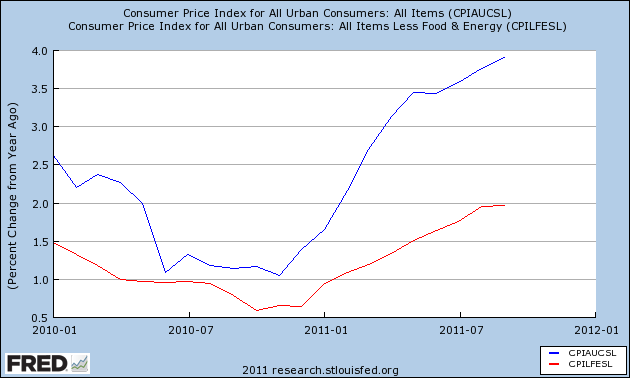
So basically he wants to increase our inflation target to 3% to allow us more leeway to reinflate the economy and get unemployment under control. There is only one problem, according to the latest CPI figures, inflation is already up by 3.9% over the last 12 months, up from less than 2% at the beginning of the year.  I do realize of course that he is not thinking about actual CPI, but the statistical and non-real world subset that is considered "core" CPI, which is CPI less food and energy (let me know if you find anyone walking the street who can get by without food or energy expenditure).  But as you can see from the graph below, even core CPI (the red line) is headed up and is already at the 2% target:


Even if the Fed did nothing more CPI could continue to drift higher by itself, possibly as high as Mr. Evans' new target of 3%. And the real CPI, the one you and I feel in our daily lives, could easily be north of 5-6%. How does that make any sense? And does he not remember QE2? There were few, if any, additional jobs created and all we got were higher commodity (food + energy) and stock prices. Employment just continued to stagnate, and this was after $600 billion was pumped into the economy. What Charles Evans wants is just a recipe for continued disaster.

The Democratic Proposal to Tax Financial Transactions Show They Have No Idea What They Are Doing

Senator Tom Harkin (D-Iowa) and Representative Peter DeFazio (D-Oregon) are set to propose a tax on financial transactions similar to what is being proposed in Europe (as if that lends them any support).  It is being marketed by the folks behind it as very small, so small that Tom Harkin bets that "nobody would even feel it".  Statements like that further convince me that he has absolutely zero knowledge of the financial world, not surprising given that he has had a total of 2 years of private sector experience (practicing law 37 years ago after he lost a Congressional election) in the last 49 years. 

The tax they are proposing seems small at first glance, only 0.03% on trades of stocks and bonds but you don't have to dig too deep to see how this could have a huge impact.  Most firms right now are paying a penny a share to trade a stock, sometimes less than half a penny but let's assume they pay a penny for illustrative purposes.  If you have a $50 stock, in percentage terms, that commission amounts to 0.02%.  So if you have to add the financial transactions tax on top of that, you are suddenly paying 0.05% in taxes plus commission for the trade, increasing your costs by 150%.  Changes of that magnitude add up quickly especially if you do any short term trading.  At a hedge fund, even if you have long term core positions it is easy to get up to 10,000% annual turnover (you might have short term trades after a stock got killed because of bad earnings or you might be taking index etf hedges on and off a few times a year).  With turnover like that, the 0.03% tax ends up costing your investors an additional 3% on the year.  And when you add that 3% to the 2% in management fees and then 2% in commissions you usually charge that means your stocks need to appreciate 7% before your investors start to even make any money! 

Now let's not forget the high frequency trading shops.  They do a massive number of trades at low cost to them trying to eek out pennies or fractions of pennies and accounted for 73% of all US equity trading volume in 2009.  That would completely destroy that business model as it relies on almost zero transaction costs and all those PhD's will be out looking for work when there is none.  While I am sure there are lots of people who want those firms to go out of business, there will be one major negative impact of this, the liquidity in the markets will dry up, especially if run of the mill funds also stop much of their short term trading.  Less liquidity means that you will have to pay more to buy a stock and get less when you want to sell it, which will hurt all investors, both big and small.  And to top it all off, with so much of the volume on the markets gone, this tax will raise a small fraction of what Harkin and DeFazio wanted to in the first place.

It really is mind boggling that anyone would even propose such a travisty which will have so many unintended consequences. 

Tuesday, November 1, 2011

In the Markets, When it Rains it Pours

It's amazing that just late last week that the market seemed to come together to sing Kumbaya.  Stocks were soaring and people (okay mostly idiots) were thinking the EU crisis might finally be solved.  Fast forward to today and you find we've just had the 8th largest bankruptcy in history and it looks like absolutely nothing with regards to Europe is set in stone.  Or even written in the sand.  Or drawn on an imaginary chalkboard. 

Anyway, let's start with the bankruptcy of MF Global which has a lot of people joking about what the MF stands for (you can use your imagination).  Despite the fact that it was run by Jon Corzine, former Governor and Senator from New Jersey and, most importantly, co-head of the cabal at Goldman Sachs, the firm went bankrupt on a massively wrong bet on Italian debt (really, you're betting on the Italians righting their ship?  Didn't Prime Minister Berlusconi say he wanted to change his party name to Go Pussy!?) and appears to have funneled money from client accounts in the process.  So there is a possibility that some of MF Global's clients could be wiped out in all this, forcing them to sell many of their other holdings to fill the hole created by MF Global.  Also, and this could be more serious, any time any of the smaller firms get even a whiff of a bankruptcy rumor around them people will just want to pull their money first and ask questions later, and will practically have a fiduciary responsibility to do so.  This would basically cause runs on all the smaller brokers out there and cause major market dislocations in very short order.  As I mentioned before, losing confidence in a stock or an economy is one thing, losing confidence in the actual functioning of the market is far, far worse.

I'm also amazed at how quickly MF Global imploded after the supposedly great EU summit in which they came up with a plan (or more precisely a goal with no details).  I think part of the reason it happened the way it did is because of the shenanigans related to credit default swaps (CDS) and Greek debt.  As I mentioned last Thursday, the plan to give investors a 50% haircut without triggering the CDS's would wreak havoc on the bond markets.  Everyone who bought a CDS as insurance would realize they are probably worthless and their 0% default risk exposure might be 100%.  This will cause them to sell the government bonds with default risk to lower their exposure.  So as other investors started selling their Italian bonds, this caused MF Global to really feel pain, and if they owned any CDS's they would feel double pain as the value of those would be going down as well (as people lose confidence at their value).  Instead of having a hedged position where movement in bonds is mirrored by opposite movements in CDS's they would actually see the two of them move in tandem.  Basically, they may have found themselves in a situation where instead of 0% exposure, their portfolio acted as if they had 200% exposure (both the bond and the hedge going down at the same time instead of offsetting), a very dangerous thing with a levered book, as MF Global had.  When hedges don't work the way you think, bad things happen.

Then you have the announcement of the Greek referendum which has everyone shocked and appalled as they know there is a significant chance that a referendum on the bailout package would fail and Greece would messily default.  Of course the reason the bailout would fail is because it a) doesn't solve anything and b) severely punishes Greek citizens, many of whom probably didn't benefit at all from the debt binge (at least not directly).  The reason I say it doesn't solve anything is that the 50% haircut is not on ALL debt, it is only on debt held by private investors.  The ECB and IMF will face no haircut at all and other publicly held debt will only face a 21% haircut.  So after all that Greece will still have 275 billion euros of their original 350 billion euros outstanding.  And then to top it all off, after all the austerity plans the hope is that Greece will end up with debt-to-GDP at 120% in 8 years, which by all historical accounts is still an unsustainable amount (historically anything over 90% leads to default eventually).  Why again should a Greek citizen vote yes to the proposed referendum?  I know that if I were a Greek version of the real me (far from retirement and working in the private sector) I would definitely vote no.  I would want us to go back to the friggin Drachma which will allow us to print our way out of this mess and without the damn Germans telling me what to do.  The initial contraction will be deeper but the time spent in pain will be much shorter.  I guess everyone understands this logic or they wouldn't be flipping out like this.  Even if enough pressure is put on Greece to cancel the referendum I think the ruling socialist government is done for and there could be new Greek elections in a matter of weeks where I think the anti-Germans-telling-the-Greeks-what-to-do forces will probably prevail (the fact that many of those are the ones that cooked the books in Greece in the first place is besides the point). 

All of this is really only good news if you are short the market or if you are a Cain supporter.  It really looks like Cain got lucky again as, in this new cycle, nobody but diehard pundits who watch C-Span for fun even care about the allegedly inappropriate but non-sexual gesture he might have made over a decade ago.  Or his suspect denials.

Explaining Taxes to Children Using Halloween Candy


(h/t Econlog)

A Hands-On President


(h/t Powerline)